

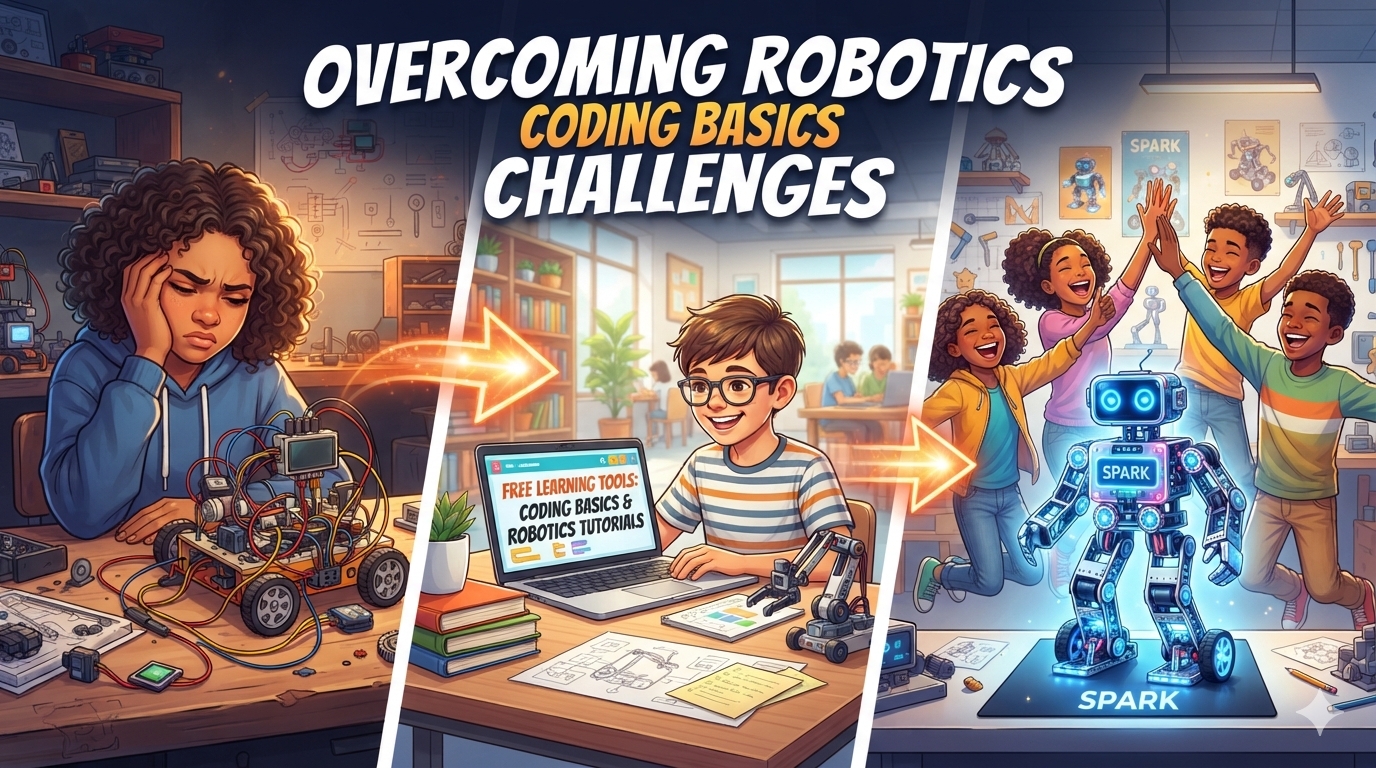

A. Dealing With Frustration When a Project Does Not Work as Expected
This is the challenge that shows up most often and matters most. Robotics projects fail. Often. And for children who are used to getting right answers quickly, this can be genuinely upsetting.
A child might spend an hour building a robot and then find that it moves in the wrong direction when they run the code. Or a sensor doesn't detect anything. Or the robot just sits there and does nothing. These moments test patience, and not every child handles them well at first.
A few things that help
Normalize failure early Parents and teachers can reframe failure as information rather than a mistake. "It didn't work" is not the same as "I did something wrong." It means "I learned something about what doesn't work, which brings me closer to finding what does."
Break projects into small steps Testing each component before assembling everything reduces the number of things that can go wrong at once, and makes problems easier to locate when they do appear.
Take breaks: When frustration runs high, stepping away for ten minutes and coming back with fresh eyes genuinely works. Many experienced engineers and programmers report that their best ideas come when they've stopped trying so hard.
Encourage journaling: Keeping a simple record of what was tried and what happened helps children see their own progress, even when a project isn't finished yet.
B. Finding Access to Materials, Tools, and Learning Resources
Not every family has the budget for robotics kits, and not every school has a well-funded STEM program. This is a real barrier, and it's important to acknowledge it honestly rather than pretend it doesn't exist.
That said, there are meaningful ways to reduce the cost of entry.
Public libraries increasingly offer maker spaces and lending programs for robotics kits and equipment. It's worth checking what's available locally.
Free online resources like Scratch (scratch.mit.edu), Arduino tutorials, and YouTube channels dedicated to beginner robotics remove the software cost entirely.
Community organizations such as 4-H, Boys and Girls Clubs, and public library programs often run free or low-cost robotics workshops, especially in underserved communities.
School programs and grants— Many schools can access grants specifically for STEM and robotics equipment. Teachers who are interested in starting a program can often find funding through organizations like the National Science Foundation or local foundations.
DIY approaches— Some of the most creative robotics projects have been built from cardboard, rubber bands, recycled electronics, and inexpensive hobby parts. The sophistication of the materials is far less important than the quality of the thinking.
C. Staying Motivated and Consistent Over a Long Period of Time
Learning robotics is not something that happens in a single weekend. It builds over months and years, and motivation naturally fluctuates during that time. Children who start with high enthusiasm sometimes hit a plateau where progress feels slow and the initial excitement has worn off.
Ways to help sustain motivation over time
Set small, visible goals. Instead of working toward a large finished project, celebrate smaller wins — the first time code runs without errors, the first time a sensor responds correctly, the first time a robot completes even part of a task.
Connect robotics to what the child already cares about. A child who loves animals might be motivated by building a robot that mimics how a crab moves. A child who loves music might want to build a device that creates sounds. Connecting the learning to personal interests keeps it meaningful.
Find a community. Whether it's a school club, an online forum, or a weekend maker group, being around other people who share the interest provides encouragement and inspiration. Seeing what other kids have built motivates children to push their own work further.
Share the work. Having an audience — even just family members or classmates — gives children a reason to finish and a sense of pride in what they've accomplished.
Recommended Certifications in Robotics & STEM
 Beginner
Game Development & AI with Mblock (Credo)
This course introduces students to coding and AI using Mblock through interactive game development…
 Beginner
Computer Basics for Kids: Machines, Robots & Smart Systems (Credo)
This course introduces young learners to computers, machines, and robots through engaging stories, activities,…