Key Concepts of Financial Literacy
Oct 22, 2026 · @Teacherdadaplus

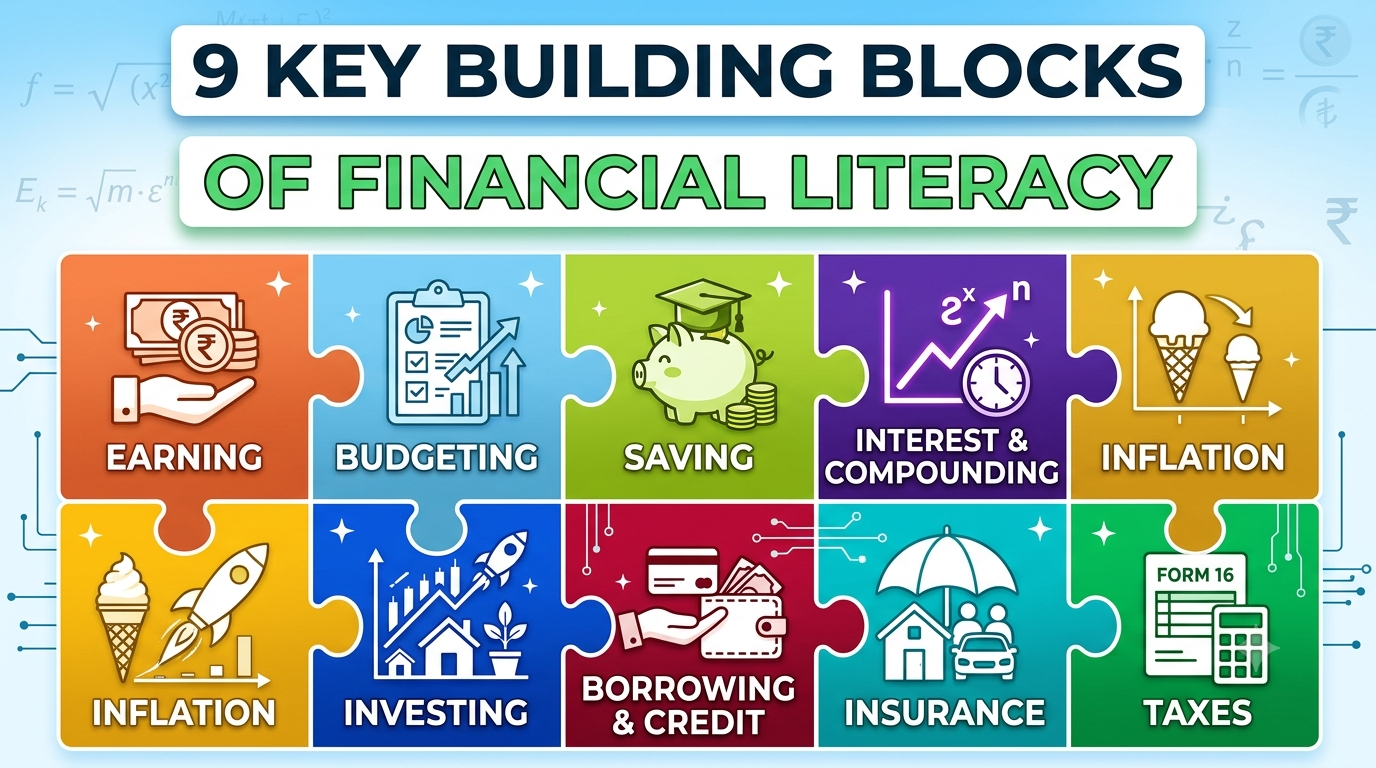
These are the 9 building blocks. Here's the quick view first, then each one explained with a real example and something to try.
|
Concept |
What it means in one line |
Good age to start learning |
|
Earning and income |
Where your money comes from |
5-10+ |
|
Budgeting |
A plan for where your money goes |
5-10+ |
|
Saving |
Keeping money aside for later |
7-10+ |
|
Interest and compounding |
How money grows (or debt grows) over time |
12+ |
|
Inflation |
Why things cost more each year |
12+ |
|
Investing |
Putting money to work so it grows |
15+ (with a parent) |
|
Borrowing and credit |
Using someone else's money, at a cost |
16+ |
|
Insurance |
Protecting yourself from big, sudden costs |
18+ |
|
Taxes |
Your share paid to the government from what you earn |
18+ |
1. Earning and income
Income is any money that comes to you: pocket money, a stipend, a part-time job, or payments from freelance clients. The key idea is the difference between gross and net. If a client pays you ₹10,000 but deducts 10% tax (TDS) and the payment app charges a fee, what reaches your account is less than ₹10,000. Always plan with the amount you actually receive.
Try this: Write down every rupee you received last month and where it came from.
2. Budgeting
A budget is simply a plan that tells your money where to go, before it disappears on its own. A popular method is the 50/30/20 rule: 50% for needs, 30% for wants, and 20% for savings.
Here's how it looks for a student with ₹1,000 a month in pocket money:
|
Category |
Share |
Amount |
Example |
|
Needs |
50% |
₹500 |
Bus pass, stationery, school snacks |
|
Wants |
30% |
₹300 |
Movie, game top-up, treats with friends |
|
Savings |
20% |
₹200 |
Goal: new headphones in 6 months |
For younger kids, the jar method works better: three jars labelled Spend, Save and Share, and every rupee goes into one of them.
If you're a freelancer, your income isn't steady, so budgeting matters even more. Take Aisha, a 23-year-old graphic designer who earned ₹45,000 one month and ₹15,000 the next. She now moves all client payments into one account and pays herself a fixed ₹22,000 every month from it. The good months fill a buffer that covers the slow ones.
Try this: Track every rupee you spend for 7 days. Most people are surprised by at least one category.
3. Saving and the emergency fund
The most useful saving rule is pay yourself first: move your savings out the day money arrives, not whatever is left at the end of the month. (Usually nothing is left.)
Once you're earning, build an emergency fund of 3–6 months of expenses. Rohan, 24, spends about ₹25,000 a month, so his target is ₹75,000 to ₹1.5 lakh. That money is for job loss or a medical bill, not a sale. A savings account, a recurring deposit (RD) or a fixed deposit (FD) are good places to keep it, because it should be safe and easy to withdraw.
Try this: Set up an automatic transfer of even ₹100 to a separate savings account on the day your money comes in.
4. Interest and compound interest
Interest is the price of money. When you save, the bank pays you interest. When you borrow, you pay it.
Simple interest is earned only on your original amount. Compound interest is earned on your original amount and on the interest you've already earned. That's why it snowballs.
Example: if you invest ₹500 every month for 10 years and earn 8% a year, you put in ₹60,000 but end up with about ₹92,000. The extra ₹32,000 is compounding at work.
Time matters even more than the amount. Compare two people who each invest ₹1,000 a month at an assumed 10% a year until age 52:
- Priya starts at 22 and invests for 30 years. She puts in ₹3.6 lakh and ends up with about ₹22.8 lakh.
- Rahul starts at 32 and invests for 20 years. He puts in ₹2.4 lakh and ends up with about ₹7.7 lakh.
Priya invests only ₹1.2 lakh more, but ends with three times as much, just because she started 10 years earlier. (Returns are never guaranteed, but the lesson holds.)
A handy shortcut is the Rule of 72: divide 72 by the interest rate to find roughly how many years your money takes to double. At 8%, money doubles in about 9 years.
Try this: Use a free online SIP calculator and see what ₹500 a month becomes over 5, 10 and 20 years.
5. Inflation
Inflation is the rise in prices over time. Your parents probably remember a samosa costing a few rupees.
If inflation runs at 6% a year, something that costs ₹100 today will cost about ₹179 in 10 years. This is why money kept under a mattress, or in an account earning less than inflation, quietly loses value. Your savings need to grow at least as fast as prices to keep up.
Try this: Ask a parent or grandparent what a movie ticket, a litre of milk or a bus fare cost when they were your age.
6. Investing basics
Investing means putting money into something that can grow, like shares, mutual funds or government schemes. Three ideas matter most:
- Risk and return go together. Higher possible returns come with a higher chance of loss. An FD is low risk, low return; shares are higher risk, higher potential return.
- Diversify. Don't put all your money in one place. A mutual fund spreads your money across many companies.
- Start small, stay regular. A SIP (Systematic Investment Plan) lets you invest a fixed amount, even ₹500, in a mutual fund every month.
Common options in India include mutual funds via SIP, the Public Provident Fund (PPF), fixed deposits, and shares. If you're under 18, you can't invest on your own, but a parent or guardian can open a minor account (such as a minor PPF or a minor mutual fund folio) in your name. Learn the concepts now; invest with an adult's help.
Try this: Pick one mutual fund and read its factsheet: what it invests in, its risk level, and its past returns.
7. Borrowing, credit and your credit score
Borrowing isn't bad. An education loan can be a smart investment in yourself. The problem is borrowing without understanding the cost.
- EMI (Equated Monthly Instalment) is the fixed amount you repay each month on a loan.
- Credit cards are interest-free only if you pay the full bill by the due date. Pay just the "minimum due" and interest of around 3–3.5% a month kicks in, which is roughly 36–42% a year. Leave a ₹20,000 bill unpaid for a year and it can grow to about ₹30,000.
- Buy Now, Pay Later and "0% EMI" offers often hide processing fees or late charges. Read the fine print.
- Your credit score (like a CIBIL score, which ranges from 300 to 900) shows lenders how reliably you repay. A score above 750 usually gets you loans at better rates. Late payments pull it down.
Try this: If you have a credit card, set up autopay for the full amount, not the minimum.
8. Insurance and protecting yourself
Insurance is how you protect your savings from one big, unexpected cost. You pay a small, regular amount (the premium) so the insurer pays if something goes wrong.
A few days in a private hospital can easily cost ₹1–2 lakh, enough to wipe out years of savings. That's why health insurance comes before investing. Once someone depends on your income, a term insurance plan protects them if something happens to you.
One important lesson: insurance is for protection, not for growing money. Many policies sold as "insurance plus investment" give low returns. It's usually better to buy simple insurance and invest separately.
Try this: Ask your parents whether your family has health insurance, and what it covers.
9. Taxes
When you earn above a certain limit, you pay a part of your income as income tax, which funds roads, schools and hospitals. Basics every young earner should know:
- You need a PAN (Permanent Account Number) for most financial work, from opening a demat account to receiving freelance payments.
- You file an ITR (Income Tax Return) each year to report what you earned. Even if your income is below the taxable limit, filing can help you claim back TDS that clients deducted.
- India has an old and a new tax regime with different slabs and deductions. Check the current rules on the official income tax portal each year, since they change.
Try this: If you freelance, check your Annual Information Statement (AIS) on the income tax portal to see the TDS your clients have deducted
Enhance Your Financial Skills with TeacherDadaPlus
Explore financial literacy and practical finance concepts with TeacherDadaPlus. Build your understanding of budgeting, financial planning, forecasting, and investment analysis through industry-relevant learning resources designed to strengthen your financial knowledge and support career growth.
Develop essential financial skills and take the next step in your learning journey with TeacherDadaPlus today!
Recommended Certifications in Financial Literacy
 Beginner
AI & Data Science Fundamentals: From Concepts to Real-World Projects
A practical beginner-friendly course covering AI, machine learning concepts, generative AI, computer vision, IoT,…
 Intermediate
Digital Brand Building, Marketing & Visual Content Creation
This course teaches learners how to build and launch a digital brand through brand…