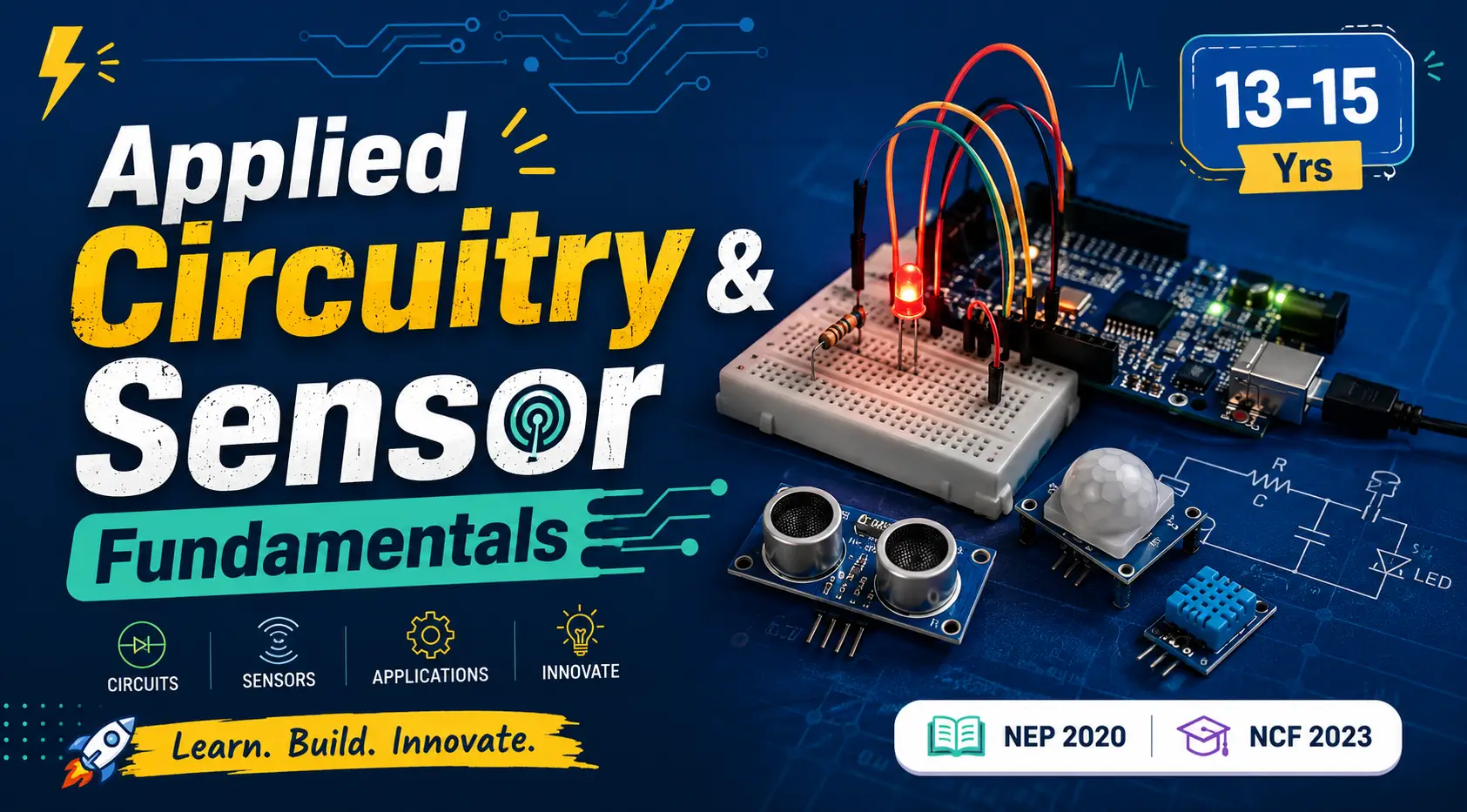
Applied Circuitry & Sensor Fundamentals
This hands-on course provides an engaging introduction to the core principles of electrical circuits and the role of sensors in modern technology.
Dhanaji Suryawanshi
Robotics Instructor
Here’s what you will learn?
- Understand the fundamentals of sensors and explain their role in modern electronic systems and automation.
- Identify different types of sensors and classify them based on their functions, applications, and working principles.
- Differentiate between sensor categories and subtypes, including commonly used environmental, motion, light, and proximity sensors.
- Understand how sensors interact with electronic circuits to collect and transmit information.
This Course Includes
- Recorded Lessons: 27
- Recorded Hours: 14hr 12min
- Certificate of completion
- Access on Mobile
Course Description
This hands-on course provides an engaging introduction to the core principles of electrical circuits and the role of sensors in modern technology. Through a series of practical projects, learners will explore fundamental concepts like voltage, current, resistance, and the behavior of different circuit types. The course bridges theory and real-world application, enabling participants to build, test, and troubleshoot their own electronic circuits.
You will explore the fundamental concepts of electric circuits, including basic components and the differences between AC and DC circuits.
You can Apply circuit knowledge to build a simple functional project, demonstrating how electricity can drive mechanical action (e.g., a fan).
Further your practical skills by creating another motor-based project, such as a water pump, illustrating the use of circuits in controlling motion.
You will learn to design a circuit that uses LEDs to visually indicate the charge level of a battery, incorporating principles of voltage division.
You can Build a unique digital-themed lighting project, integrating the principles of previous lessons into a creative application.
At last, you will delve into the world of sensors, covering various types (temperature, vision, force, etc.) and understanding how they detect environmental changes and convert them into electrical signals for processing.
Course Content
27 Lessons | 14hr 12min
About the instructor

Dhanaji Suryawanshi
Robotics Instructor
Dhanaji Suryawanshi is a passionate Robotics Mentor dedicated to bridging the gap between theoretical engineering and hands-on innovation. With a solid foundation in Engineering and practical experience in system design, he translates complex concepts into engaging learning experiences. Dhanaji's Motto of Robotics Teaching is "Empowering young minds to turn imagination into automation, not just by building robots but building engineers for the future".
Frequently Asked Questions